Home/Blog/The Real Landed Cost: Shipping, Duties & Site Installation for Modular Buildings from China
The Real Landed Cost: Shipping, Duties & Site Installation for Modular Buildings from China
The factory price is only the beginning. Sea freight, GST, oversize road permits, crane hire and site crews — a realistic line-by-line budget for getting a Chinese-made modular building delivered and standing on an Australian site.
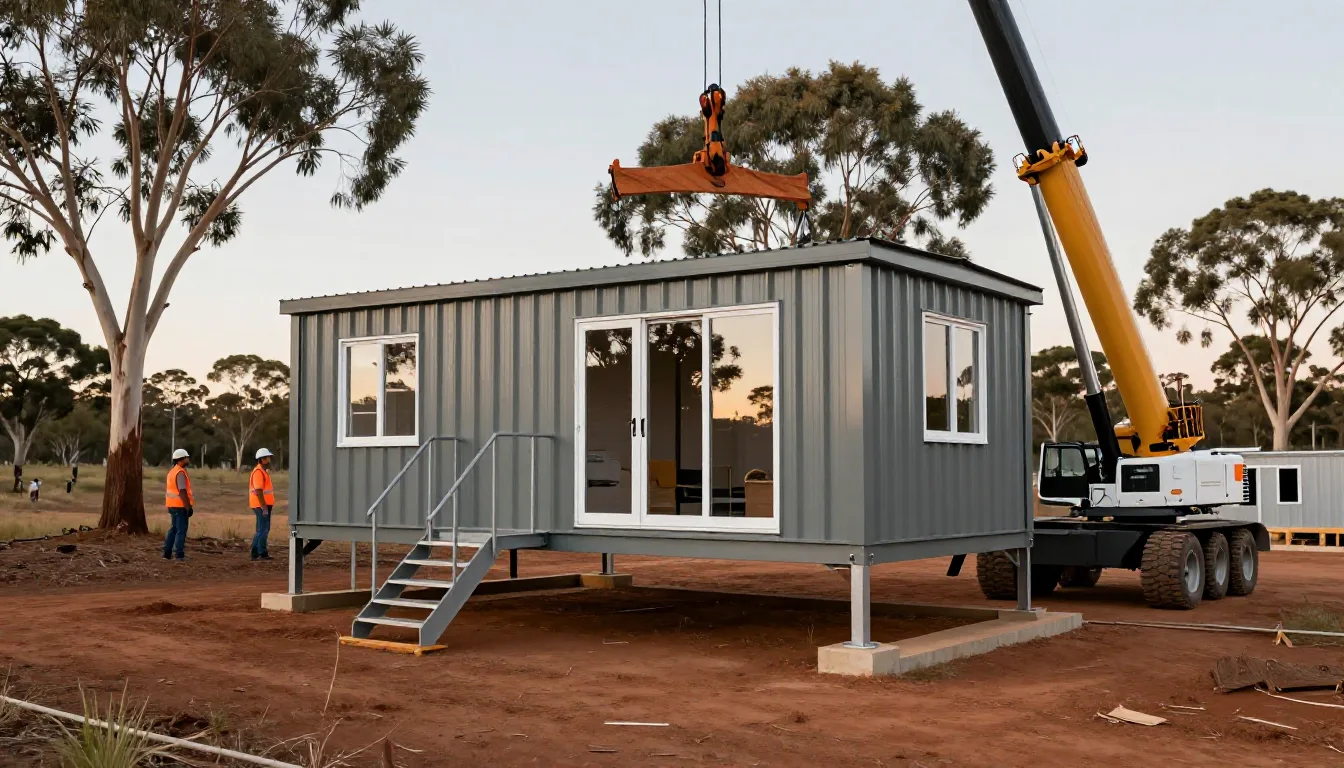
Every buyer who has priced a modular building from China has had the same moment: the FOB quote looks sharp, and then the freight forwarder, the customs broker, the transport company and the crane operator each send their own numbers. The gap between the FOB price and a building standing on your site — the landed cost — is where budgets are won or lost. This guide walks through every cost line between the factory gate and handover, with indicative 2026 ranges, so the spreadsheet is complete before the deposit is paid.
The Cost Map: Factory Gate to Handover
A useful way to think about landed cost is five buckets: international freight, import charges, domestic transport, installation, and site works. The FOB price covers none of them. Buyers who budget only for freight typically find the true gap is two to three times the shipping line's invoice. For the bigger procurement picture, see our complete guide to importing modular buildings from China.
| Cost Bucket | What's Inside | Who Quotes It |
|---|---|---|
| International freight | Ocean freight, BAF or currency surcharges, origin port charges | Freight forwarder |
| Import charges | GST (10% of CIF + duty), duty where applicable, customs brokerage, quarantine inspection | Customs broker |
| Domestic transport | Port-to-site trucking, oversize permits, pilot or escort vehicles | Heavy haulage carrier |
| Installation | Crane hire, rigging crew, module joining, weather sealing | Crane company + install crew |
| Site works | Footings or stumps, service connections, access preparation, design coordination | Local builder or civil contractor |
International Freight: Volatile but Quotable
Most modular buildings ship as breakbulk or on flat racks, because a finished module rarely fits inside a standard container. Smaller buildings — bathroom pods, flat-pack cabins, wall panels — can go in 40 ft high-cube containers, which is where the sharp pricing lives. Indicative 2026 ranges for a 40HQ from major Chinese ports to Sydney or Melbourne run roughly USD 1,500–3,500 per container, but breakbulk and flat-rack rates are quoted per shipment and move with the market. Treat any freight number older than about eight weeks as stale.
Sea transit from northern or eastern Chinese ports to Australia's east coast typically runs about two to three and a half weeks, plus three to seven days for port clearance on arrival. Build a buffer: cyclone season, port congestion and rolled bookings add a week or two more often than anyone plans for.
Import Charges: The Ones Buyers Forget
Two numbers anchor this bucket. First, duty: under the China–Australia Free Trade Agreement, the tariff on the overwhelming majority of Chinese building products is zero. Confirm the specific HS code with your broker, but for most modular buildings and components there is no duty to pay. Second, GST: 10% applies to the taxable importation, calculated on the customs value plus duty plus international freight and insurance — the CIF-plus base, not the factory price. GST-registered businesses generally claim it back as an input tax credit, but it is a real cash-flow event at the border.
Around those two anchors sit the smaller charges that still sting: customs brokerage fees, port service charges, and biosecurity. Any timber packaging — pallets, crates, dunnage — must comply with ISPM-15 and be stamped, or the consignment risks treatment, re-export or destruction at the importer's cost. We insist on ISPM-15-compliant or non-timber packing as a factory-gate specification for exactly this reason.
Domestic Transport: Where Width Costs Money
This is the bucket that surprises first-time importers most. A module wider than 2.5 metres is an oversize load on Australian roads. That means state road authority permits, restricted travel times, and pilot or escort vehicles — plural, once you pass about 3.5 metres wide. Indicatively, pilot vehicles run a few dollars per kilometre each, permits are per journey per state, and a multi-module project from port to a regional site can see the transport line rival the ocean freight.
| Module Width | Road Status | Typical Requirements |
|---|---|---|
| Up to 2.5 m | Legal load | Standard trucking, no special permits |
| 2.5 m – 3.5 m | Oversize | Permits, travel time restrictions, pilot vehicle(s) depending on route |
| Over 3.5 m | Oversize (higher class) | Multiple pilots, route surveys, possible police escort in some states |
Design implication: module width is a landed-cost decision, not just a floor-plan decision. A 3.4 m-wide module and a 3.6 m-wide module can differ by thousands of dollars per building in transport alone, before anyone talks about joinery. We cover the supplier-side questions in our supplier selection guide — width versus route is one to raise early.
Installation: Crane Day and Crew Week
On site, the budget splits into the lift and the fit-out. Crane hire is quoted by capacity and duration — indicatively from a few thousand dollars for a day with a smaller all-terrain crane on a single-module job, to five figures when a large crane is needed for multi-storey or tight-access lifts. Then comes the crew: setting out on footings, joining modules, sealing the marriage line, and weathering in. A straightforward single-module granny flat might see a crew of three or four for a few days; a multi-module camp is a scheduled program. For remote camp pricing context, see our mine camp cost guide.
Access is the hidden variable. Crane pads, overhead powerlines, tree canopies and ground bearing capacity all feed the crane quote, and none of them appear in the freight forwarder's spreadsheet. A ten-minute site video and a services dial-before-you-dig report sent to the installer before quoting is worth more than a site visit after it.
A Worked Example: Two-Module Granny Flat, Sydney
| Line | Indicative Range (AUD) | Notes |
|---|---|---|
| FOB factory price | (project-specific) | The number everyone starts with |
| Ocean freight + origin charges | 3,000 – 8,000 | Flat rack or breakbulk, market-dependent |
| Duty | 0 | ChAFTA — confirm HS code with broker |
| GST at border | 10% of CIF + duty base | Claimable for GST-registered buyers |
| Brokerage + port + biosecurity | 800 – 2,000 | ISPM-15 packing avoids treatment risk |
| Port-to-site transport (oversize) | 2,000 – 6,000 | Width class and distance drive this |
| Crane + install crew | 5,000 – 15,000 | Access and module count drive this |
| Footings + service connections | 8,000 – 25,000 | Site works — local contractor |
Add it up and the honest planning allowance on top of the FOB price is commonly 30–60% for a straightforward metro project, and more for remote or difficult sites. None of that is a reason not to import — the FOB price advantage usually survives it comfortably — but it is every reason to build the full spreadsheet before comparing quotes.
What We Do Differently
At CoreSwift, landed cost is part of the design brief, not an afterthought. We quote the FOB price alongside the import and installation path — width class against your route, packing spec against biosecurity, crane plan against your site access — and we run the design coordination loop that makes the quote stick: your local planner produces the site master plan; we translate it into module layout and box-split drawings, including switch, socket and switchboard positions; your hydraulic and electrical contractor develops their design from our layout — ideally the same firm for both trades — and we review, optimise and return signed markups before deepening the steel and fit-out documentation. That is why we ask for the project address, the master plan, the climate zone and the site classification before quoting: the answers change the cost. The same discipline is why we run factory QA as first-article engineering sign-off, batch production to the approved sample, fresh sign-off for any new design, monthly engineer inspections and third-party QC on site at the factory: a module that passes pre-shipment verification the first time avoids the most expensive landed cost of all, a rework loop while the building sits on site. If you are pricing a project now, send us the site details and we will map the full landed cost before you commit.
Frequently Asked Questions
Do I pay import duty on modular buildings from China?
In most cases, no. Under the China–Australia Free Trade Agreement the tariff on the vast majority of Chinese building products is zero. Your customs broker should confirm the specific HS code, but for most modular buildings and components there is no duty — only the 10% GST on the taxable importation, which GST-registered businesses generally claim back.
How much does it cost to ship a modular building from China to Australia?
It depends on how it ships. Containerised components in 40ft high-cubes run indicatively USD 1,500–3,500 per container to east-coast ports, while finished modules ship as breakbulk or flat racks at per-shipment quoted rates. Freight markets move fast — treat any quote older than about eight weeks as stale.
When does a module need an oversize transport permit in Australia?
Any module wider than 2.5 metres is an oversize load and needs state road authority permits, restricted travel times, and usually pilot or escort vehicles. Above roughly 3.5 metres wide, expect multiple pilots and route surveys. Module width is a landed-cost decision — a few hundred millimetres can change the transport budget by thousands of dollars.
What is the total landed cost on top of the FOB price?
For a straightforward metropolitan project, a realistic planning allowance is 30–60% on top of the FOB price, covering freight, GST cash flow, brokerage, oversize transport, crane and crew, and site works. Remote sites, tight access and wider modules push beyond that. Build the full line-by-line budget before comparing factory quotes.
Planning a Modular Building Project?
Get a free compliance pre-check for your project. We'll review your site requirements against Australian standards and tell you exactly what's needed.